As discussed in my previous post, Let’s Do Some Keyword Research, I’ve divided the keyword research topic into three different subtopics. These are the following:
- Keyword Evaluation
- Competition
- Exploration
To begin with, there will be three different subtopics under keyword evaluation. These are the following:
- Keyword Evaluation
- Search Volume
- Search Trends
- Commercial Value
- Competition
- Exploration
Today, we’ll start discussing what search volume is.
In a nut shell, search volume is basically the number of people searching for a particular keyword. To find out how many people are searching for a particular keyword, we are going to use the Google Keyword Research Tool. You may want to sign in using your Google account in order to avoid answering the captcha every time you do a keyword research.

To begin my keyword research, I’m going to input my keyword (the market that I decided to engage in, photography) in the Word or phrase box. You may also want to add some options by expanding the Advance options section. In my case, I’m going to search for All Countries. Once we are done with our search parameters, we click the Search the button.

As you can see in the image below, the keyword “photography” is being searched 11,000,000 times monthly, which means that the search volume globally of the keyword “photography” is 11,000,000. In addition, the search results that were displayed are niches under my market, photography.

Another thing that I want to discuss in this article is about match types. Match types have three different types – broad match, phrase match, and exact match. In order for us to clearly see the difference between these types, let’s look at these examples. To make things a little bit simple to follow let’s look at the search term “photography ideas “.
Match Type | Description | Example |
Exact Match | Relates to how many people are searching for the exact term “photography ideas” and then visits the top ranked websites. |
|
Phrase Match | Relates to how many people are searching for a phrase containing the words “photography ideas” in this order. |
|
Broad Match | Relates to how many people are searching for a phrase containing the words “photography” and “ideas” in any word order along with additional words. |
|
By default, Google search implements a broad match. To further demonstrate, here is an example. I searched for the keyword “photography ideas” and here is what I got:
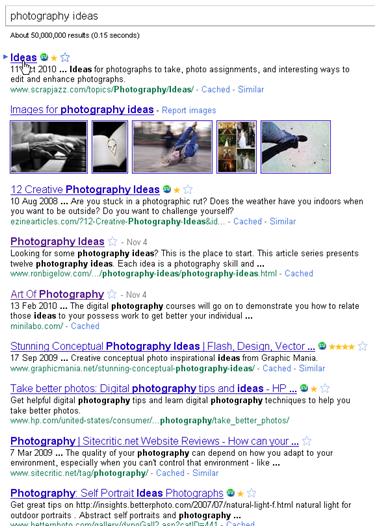
The 1st ranking website contains the word “Ideas” and not “photography ideas”. The search result also shows other variances of our keyword phrase like photography ideas, art of photography, digital photography tips and ideas, and other variations.
For us to have a phrase match in our search result, we simply add a quote before and after our keyword phrase. Here is an example:

The search results now contain our exact keyword phase “photography ideas”.
The next question is – what's the relevance of match types in search volume? Here is an example for us to have a clear view of what are the relevance of these match types.
In Google Keyword Research Tool, let’s search for our keyword phrase “photography ideas”. Once the results have been displayed, we select the three match types in the Match Types section. The results will be refreshed and will show the results of the three match types.

As you can see, there are 33,000 broad match results, 18,100 phrase match results, and there are only 2,900 exact match results. These figures are very significant because these will give us an idea on roughly how many people are searching for our target keyword monthly.
We have to take note that the search volume is not the only factor that we are considering in finding our “perfect keyword”. There are other factors that we need to consider and one of those is search trends, which will be discussed in my next article.

